BS in CS: Issue #4
If you deliver enough value, your customer will renew

There’s plenty of misinformation in Customer Success. This is a continuing series that explores common, but misleading and sometimes dangerous BS in CS. We will apply science to challenge faulty beliefs and suggest better alternatives.
Item #4: If you deliver enough value, your customer will renew
It’s an attractive notion. It implies all you need to do is meet or exceed your customer’s value expectations and your renewal is in the bag.
It’s BS. There’s no such thing as “enough” value. That’s not how the brain works. And you can do everything right, yet your customers still churn.
Why?
Value is Subjective, Relative, and Personal
Whenever the brain makes decisions, it assembles options and evaluates them. Scientists have found that many neural structures participate in the process (research papers available for download at the end of the article to paid subscribers). Shown in the scans below, for example, the ventral and dorsal posterior cingulate cortices (vPCC and dPCC) retrieve and process relevant memories. The ventral striatum (VSTR), signals payoffs for each option. The ventromedial prefrontal cortex (VMPFC) weighs context, payoffs, costs, delays, risks, and preferences:

The basal ganglia then act as judge, making the final decision when a winner emerges from the mind’s internal deliberations. Therefore, value isn’t absolute. Only relative value matters: how one alternative compares to another.
And the criteria the brain uses are subjective, not objective. Many in CS think value must be proven by numbers: time, dollars, and ROI. But our species has been around for millennia, and symbolic numbers are relatively new. So as a matter of evolution, humans rely mostly on perceptions, rather than measurable quantities, to make decisions. The brain uses numbers to justify decisions it’s already made.
What’s more, how one person perceives value differs from another. For instance, scientists have discovered a connection between personality traits and value. A 2022 experiment showed the ventral striatum, responsible for signaling payoffs, activated differently depending on a person’s degree of openness to new experiences, one of psychology’s “Big Five” personality traits. So individual differences indeed affect how people value things.
Business Decisions are Prospective
We humans frequently make choices affecting our future. For instance, even though we may not be hungry, we go to the grocery store knowing eventually we will be. Our ability to imagine future states combines episodic memory, prediction, and executive function. It allows us to plan and execute steps to obtain future payoffs. Scientists have modeled prospection, showing the brain indeed assigns values to future outcomes and internal motivational states.
And shown in the fMRI scans below, prospection is closely tied to the brain’s default mode network, a set of regions associated with daydreaming and foresight. A 2008 meta-study discovered strong correspondence between autobiographical memory (ABM), spatial navigation (NAV), theory of mind (TOM), prospection (PRO), and the default mode (DFM). This means the brain uses the same machinery for revisiting the past and imagining where we’ll be and what others will be thinking and feeling in the future. And evidence from this study once again implicates the posterior cingulate cortex (vPCC and dPCC) and its role in valuation.
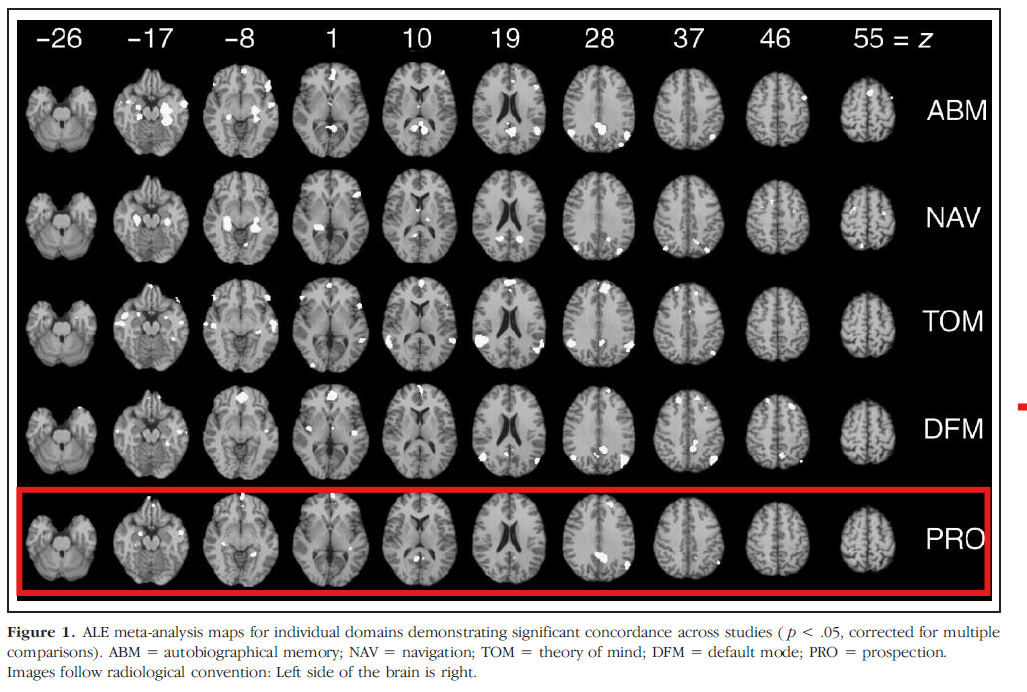
In business, few, if any, solutions deliver immediate gratification – they almost always require planning and action. This means prospective valuation always comes into play. And while positive experiences help form a brand preference, as described in my previous post, commercial decisions are based primarily on what happens next.
What to Do
Things can obviously change between the time of onboarding and renewal. An account’s needs evolve, which may uncover gaps between current and required product capabilities. New competitors may appear, promising better results for less cost. The account can reassign or hire new people to play a role in subsequent decision-making. And the customer’s business priorities and financial resources may also shift, altering the context in which decisions are made. Buyers consider all of these factors when they make decisions affecting their future.
So the common refrain, “if you deliver enough value, your customer will renew” is false. But the role of Customer Success perhaps becomes a bit more clear. It’s to create a strong, shared belief among all decision-makers that you’ve met or exceeded their value expectations and that you can be trusted. Then it’s to proactively respond to new challenges and opportunities as they arise.
It’s not about delivering enough value, but that your offerings remain the best choice.
