BS in CS: Issue #6
Customers don't churn because of price

This continuing series explores common, but misleading and sometimes dangerous BS in CS. We will apply science to challenge faulty beliefs and suggest better alternatives.
Item #6: Customers don’t churn because of price
The story goes that it’s all about value, not price. If a customer says they’re canceling because the cost is too high, then it’s just an excuse. If a CSM communicates value effectively, the cost really doesn’t matter. In fact, the vendor can increase prices without churn impact if the CSM is doing their job.
Except it’s BS. Value can’t be separated from cost. When customers make value-based decisions, they compare the prices of alternatives and the costs compared to their own financial resources. And the effects aren’t subtle. Large cost differences distort a customer’s entire perception of value.
It’s understandable how this myth may have come about. People sometimes offer socially acceptable explanations that aren’t true. At a young age we discover that being completely honest can hurt other people’s feelings, so we learn to pass our answers through social filters. But just because customers sometimes fib about the cost doesn’t mean they always do.
Cost and Value
In economic theory, value is defined as “a measure of the benefit provided by a good or service” which depends on a person’s “willingness to pay” in exchange for that benefit. Brain science concurs. As described in a previous post, neuroscientists have shown we humans make goal-directed, value-based decisions. The mind uses six factors to evaluate alternatives:
Context — conditions under which the decision is being made
Payoffs — rewards or punishments that may arise from the decision
Costs — money and effort invested to get the payoffs
Delays — the time before obtaining the payoffs
Risks — the chance of success or level of uncertainty
Preference — the favored option, based on experience
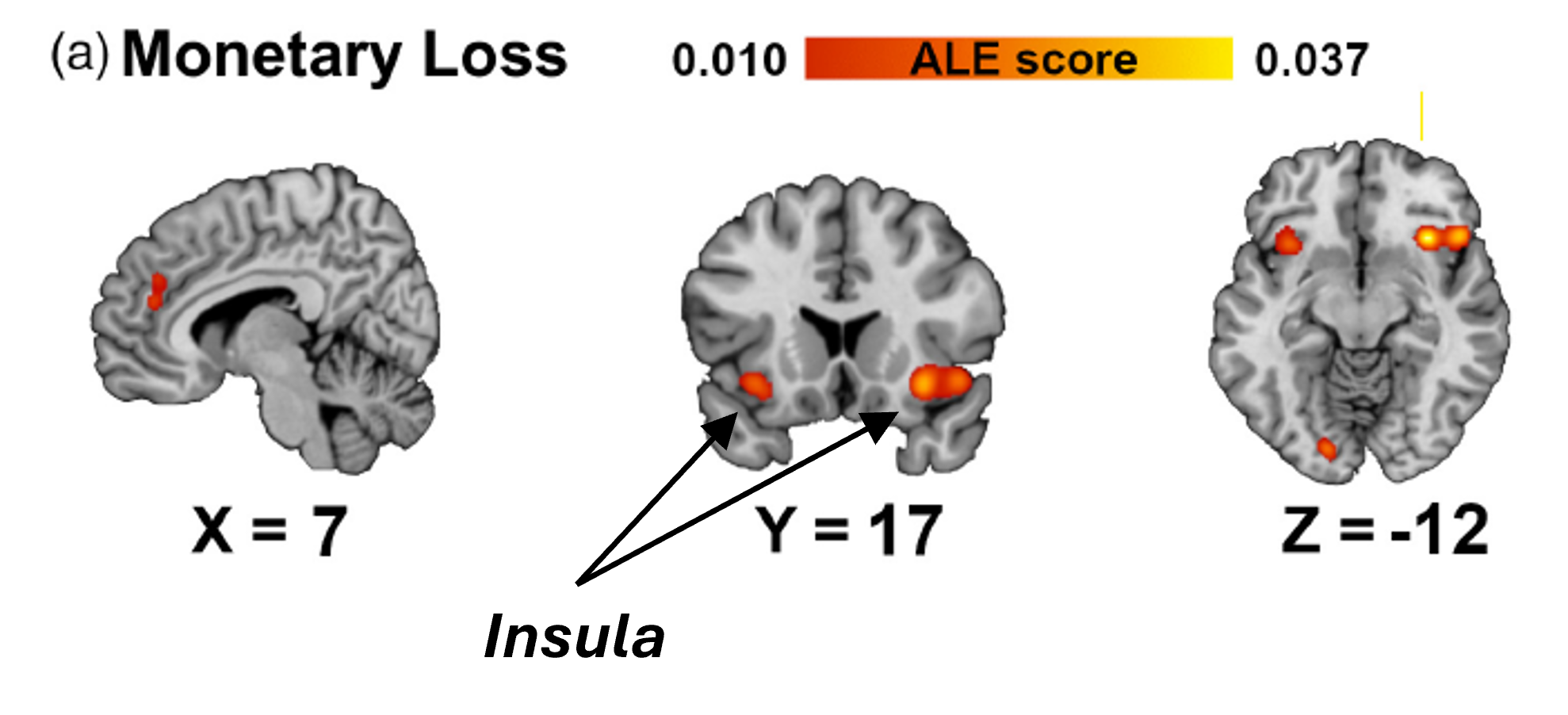
The brain considers costs in addition to other variables when it calculates value, and many neural structures participate in the process. In a 2021 meta-study (available for download to paid subscribers below), scientists showed the insula, located in the midbrain and associated with emotions, self-awareness and regulation, also senses monetary losses. The same structure processes pain, and scientists found we experience monetary losses in much the same way we do social losses. Researchers think we regard money as a type of social capital, and parting with it triggers a deep sense of pain and insecurity.
And according to prospect theory, our profound fear of losses features prominently in how we perceive value. Experiments done by behavioral economists Daniel Kahneman and Amos Tversky discovered that we’re about twice as sensitive to losses as we are to gains. Their conclusions upended classical economic theory, showing that humans react irrationally depending on the circumstances:
Faced with two choices:
A: 100% chance of losing $500
B: 50% chance of losing $1,100
People are much more likely to pick B, even though mathematically its expected losses are greater: $1,100*0.5 = $550 > $500*1 = $500. Faced with a certain loss, we’re more willing to gamble, even though it’s an illogical decision.
But when presented with a different choice:
A: 100% chance of gaining $450
B: 50% chance of gaining $1,000
We will more likely pick A, the sure bet. But this is also irrational because the expected value of B is greater: $1,000*0.5 = $500 > $450*1 = $450.
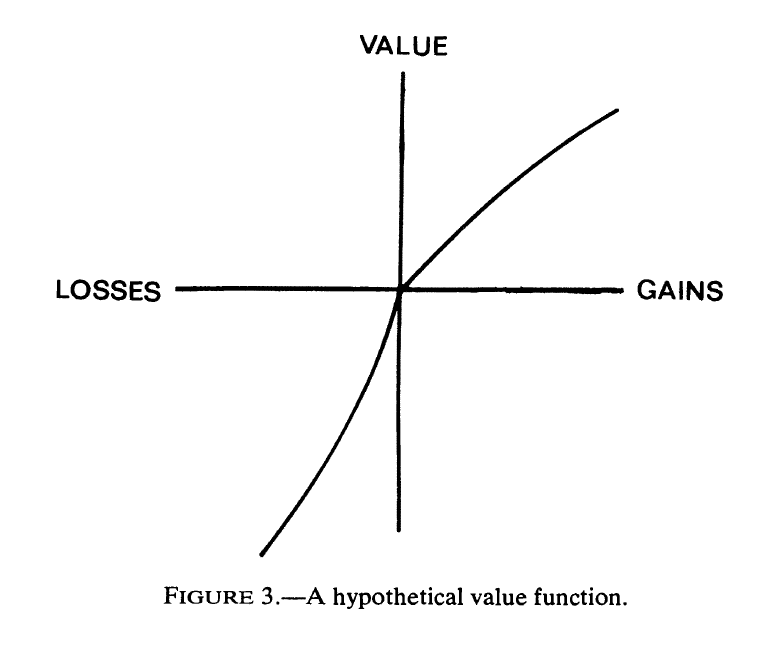
Kahneman and Tversky summarize this phenomenon in the sketch below, showing a much sharper value perception decrease in the loss domain versus the more gradual value perception increase in the gain domain. So the sting that comes from losing money is far greater than the pleasure that comes from gaining it:
Behavioral scientists have also found that the relative change, not the absolute dollar value, has more impact. For example, a billionaire may not notice a $10,000 change in his bank account because it’s a small percentage of his wealth, but the average earner certainly will. It’s the same thing in business. A $500 price increase matters more to a small business than it does to a large enterprise.
Exactly how the brain calculates gains and losses remains a bit of a mystery. Scientists aren’t sure if it uses additive or interactive models, or if it uses both depending on context:
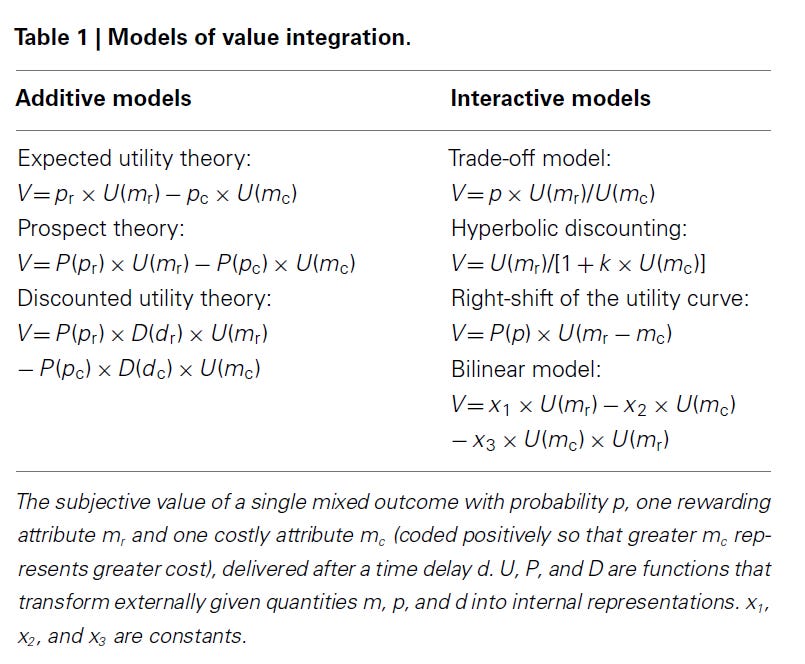
Regardless of theoretical model, however, cost (mc) is always part of the value equation. And given the circumstances, it can make a big difference.
Relationship to Delivered Value
Customer Success helps customers realize the value they expected. When the payoffs are clear and measurable, the satisfaction that comes from having made a good decision earns a preference for the provider. It’s even true if the vendor’s product costs more. A 2023 meta-study of over 100 previous studies showed customers are indeed willing to pay more for something better. But the overall correlation was moderate, r = 0.39, meaning customers are willing to pay a little more for quality, but not a lot more.
This all means Customer Success has an impact, but only to a point. If customers perceive other providers can offer the same outcomes, then price differences increasingly become a concern. Behavioral economics suggests that when gains from switching are small and customers are reasonably satisfied, then they will prefer the status quo, even if the incumbent’s pricing is a bit higher. But as cost differentials increase and the perceived losses mount, they’ll be much more willing to take risks. If the competition offers significantly lower pricing, and the costs, effort, delays and risks of changing to them are small, then churn will inevitably increase.
So the belief that superior value trumps cost is a fallacy. CSMs have some influence over a customer’s perception of value, but there are limits to what they can do. The truth is, no amount of good execution on the part of CSMs can make up for their employer’s bad pricing decisions.
Note: Paid subscribers can conveniently download the studies cited in this article below.
