Customer Delight Done Right
Too much of a good thing can be a bad thing

How should your team deliver “Wow!” experiences?
Sparingly.
Why? Customers remember when a vendor surprises them by going above and beyond. Delightful experiences usually create a vendor preference and plenty of word-of-mouth advertising. But a new study supports the intuition that there’s a downside if it isn’t managed carefully.
Unique and Special
The brain is wired to notice differences. It uses a neural architecture called predictive coding in which it constructs a mental model and compares incoming information to it. If the data agrees with the model, there’s nothing new, and the brain discards the information. If it deviates significantly, the brain takes note. With repeated feedback, it updates its model with the new information. This allows the mind to remain adaptable while minimizing precious processing power and storage.
The brain finds a moment of “Wow!” quite memorable because most of the time, sales and service interactions are routine. And people are generally satisfied when the interactions are consistently good. But when they have a difficult challenge or a special need, exceptional service makes a lasting and positive impression. Customers retell their stories to many others, creating a brand preference and biasing future purchases towards the favored provider.
Because of this, Customer Experience (CX) consultants have for many years recommended companies differentiate themselves on “Wow!” experiences. Best-selling books like Delivering Happiness: A Path to Profits, Passion, and Purpose tell how shoe retailer Zappos created a culture where delivering exceptional service made their customers exceptionally loyal. In one case, a customer service rep stayed on the phone for hours to help a stranded customer find a specific type of shoe, even suggesting competitors. In another, they sent flowers to a customer whose feet had been damaged by medical treatments. At Zappos, these stories were the norm, not the exceptions. The company’s late CEO Tony Hsieh said their eight-year growth from $1.6M to over $1B in revenue was due primarily to delivering customer happiness.
Inspired by Zappos’ success, many leaders have sought to duplicate it, but found it’s harder than it looks. First of all, not all companies are in retail. Customer support agents in banking, for example, must comply with extensive regulations, limiting their ability to bend the rules. Second, culture starts at the top. If the owners are more interested in extracting value than creating it, then investing additional time and money to build raving fans is met with criticism rather than praise. And a recent study points out a third danger—for all the goodness it delivers, delighting customers can also set a precedent.
Reciprocal Generosity
Conventional wisdom says people feel naturally obligated to return favors. After all, one good turn deserves another. But scientists at MIT ran several experiments and found that the behavior can’t be generalized. (Note: paid subscribers to this Substack can download the study below.) In six examples involving about 600 people, researchers asked test subjects to consider various scenarios. In each story, one person acted generously towards another, and scientists then asked if the other person would reciprocate. Then scientists manipulated the stories to learn how differences in social status affected the results.
The results? In symmetric relationships where people were described as peers or strangers, the study’s participants expected the recipients to follow suit. For example, if a colleague brought coffee to a meeting, they said the other would do it next time. But if there was a difference in status, such as when the boss brought the coffee, it set a precedent. They expected the manager to do it again next time.
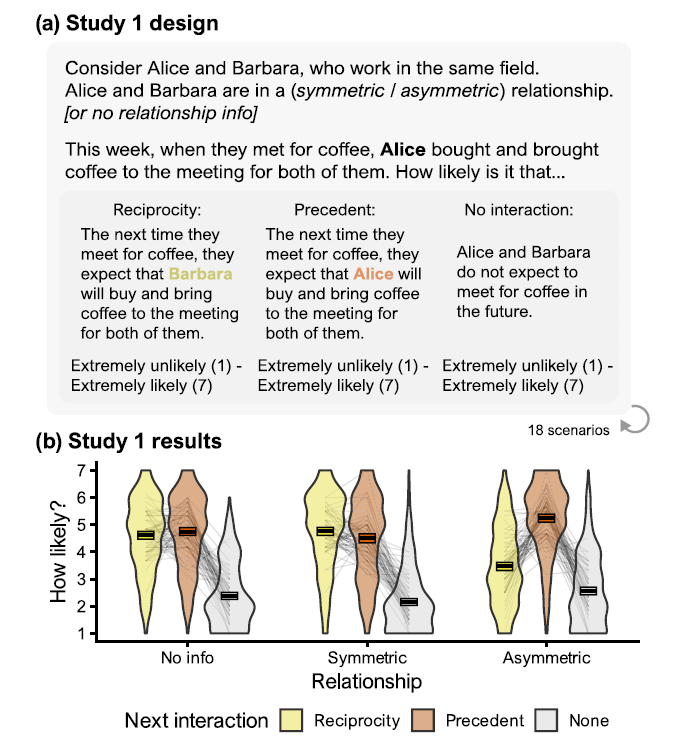
As shown above, people expect reciprocity in symmetric relationships whereas they expect precedence in asymmetric relationships. Interestingly, the direction of the gestures didn’t matter. If a subordinate did the selfless act, they were anticipated to repeat it as well. Scientists theorize that random acts of kindness tend to reinforce the social order. If a higher-ranked person is generous, it signals dominance, but if a lower-ranked person offers a gift, it signals submission. Who is consistently generous with whom depends on implied social norms. And scientists found these effects to be robust across all the experiments, meaning once inferred, expectations stick.
No Good Deed
In today’s competitive world, customers typically have more power than vendors. Most of the time they can buy from whomever they want. The usual buyer-seller relationship is therefore asymmetric. MIT’s research suggests that in this case, a gracious act (a “Wow!” experience) by the vendor automatically sets a precedent with the buyer. The customer will expect the same treatment next time and will be disappointed if it doesn’t happen.
That’s not to say frontline workers shouldn’t be kind and occasionally go the extra mile. It just means that they should be explicit, stating they’re making a one-time exception. “I can’t do it every time, but I can do it this time,” for example. Customers will appreciate the gesture and learn not to expect it in the future.
So providing routine service that meets expectations is always the starting point. And service over and above when circumstances merit boosts loyalty. But the science shows there’s a remarkably short path between a surprise and an expectation. And unless the customer’s default thinking is challenged, one kind act quickly becomes a burdensome tradition.
Paid subscribers can download the MIT study below.
