How to Establish Trust
It's earned and learned

Trust is the glue of life. It’s the most essential ingredient in effective communication. It’s the foundational principle that holds all relationships.
—Stephen Covey
Business depends on trust. Companies trust their customers will pay their bills. They trust their suppliers will deliver the materials, equipment, and services they need. And they trust their employees will show up to work each day. Counting on people makes the gears of commerce turn.
We mostly take it for granted, but trust is hard to win and easy to lose. In this two-part series, we’ll explore how trust is formed and how it can be restored. We’ll review the science and share practical advice on how to build, sustain, and re-establish trust despite the challenges.
Trust Defined
What is trust? Dr. Randy Borum from the University of South Florida describes it as a willingness to accept vulnerability or risk based on expectations regarding another person’s behavior. When we trust people, we cooperate. When we don’t, we protect ourselves.
Borum says three essential components comprise trust:
Ability—Competence, predictability and consistency in behavior
Benevolence—Caring, goodwill, empathy and commitment to shared goals
Integrity—Fairness, objectivity, honesty and open communication
Do you trust your doctor? If she’s a skilled healer, she genuinely cares about you, and she shoots straight when it comes to the diagnosis, you probably do.
Science shows the same thing applies in business. In 2001, researchers studied factors affecting trust in high technology buyer-supplier relationships (available to paid subscribers of this Substack below). Researchers asserted that customers do business with vendors because they want to (affective commitment) or because they have to (calculative commitment). They theorized that high trust associates with affective commitment and low trust with calculative commitment.
The study’s authors then developed a model:
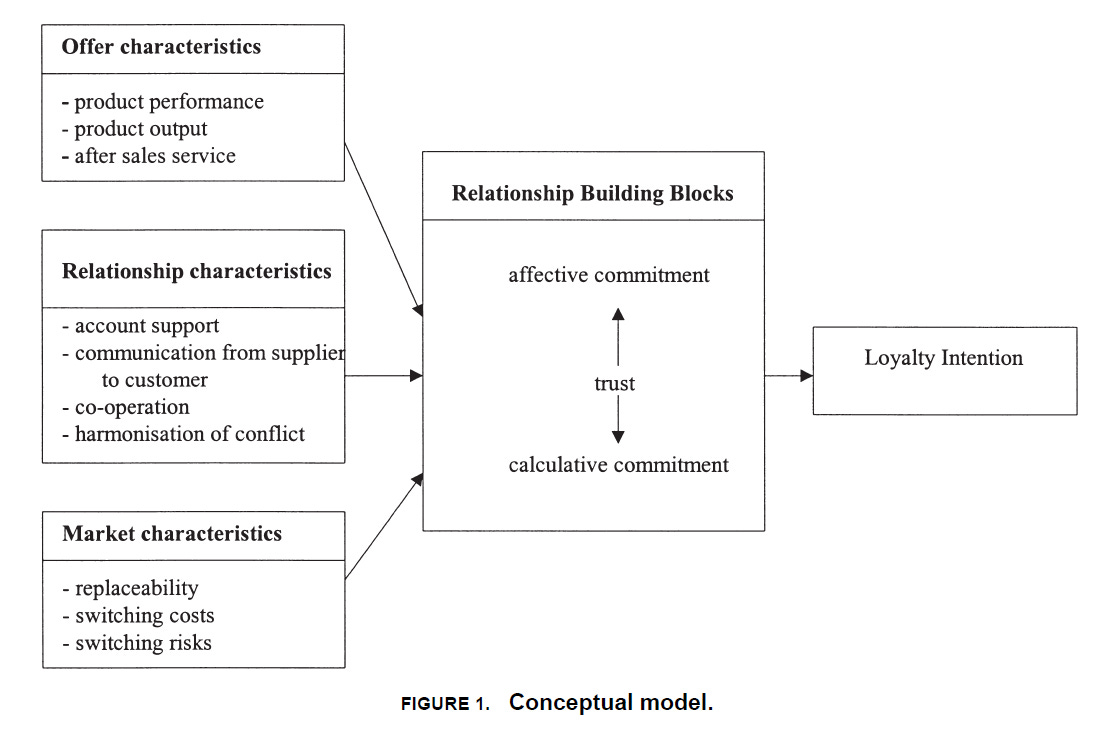
They posited that product, relationship, and market factors combined with trust perceptions would impact a customer’s intentions to continue the relationship. They then collected survey data from buyers of very high volume (VHV) copiers, used by copy shops, printers, insurance companies, banks, and educational institutions. Due to the nature of these businesses, VHV was (and perhaps still is) a mission-critical technology. VHV buyers therefore face increased risk choosing suppliers.
Analyzing survey data, the authors found that indeed high trust means high affective commitment and greater loyalty intentions. Low trust means calculative commitment and less loyalty. They showed trust is a moderating factor in decision-making and has distinct economic value.
Brain Trust
Deciding if another person is a friend or a foe was key to our evolutionary success. On the plains of the African savannah, evaluating trust when interacting with strangers was a matter of life and death. And over millennia, the brain developed specific neural mechanisms to ascertain trustworthiness.
Functional magnetic imaging studies point to specialized brain regions that evolved for calculating trust. The ventral tegmental area (VTA) releases dopamine, indicating that learning is part of trust formation. The nucleus accumbens (NAcc) signals expected rewards from collaboration, and the dorsomedial prefrontal cortex (DMPFC) integrates and updates contextual information. The DMPFC is also implicated in theory of mind, imagining what other people are thinking and feeling. This is essential in social risk calculation and decision-making.
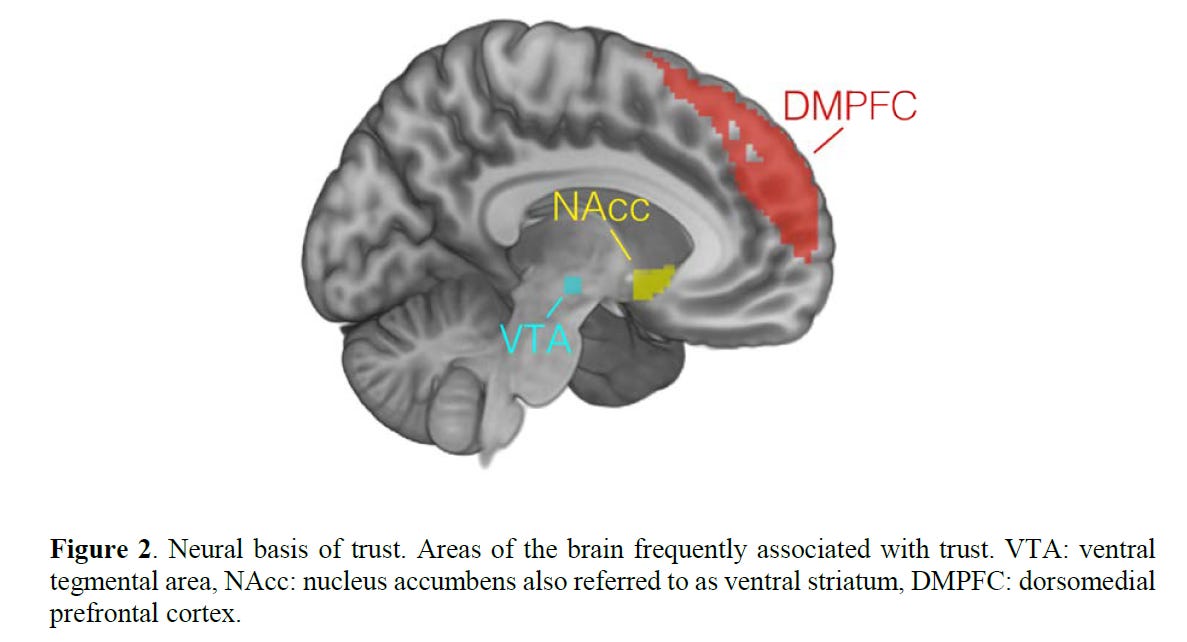
Other research has shown that the brain assigns trust values to individuals, groups, and objects, allowing us to discriminate between all three. We can trust a product and brand, for example, while distrusting a person who works for the company.
Learning to Trust
We know intuitively that trust must be earned, but it is also learned. Neuroscientists explored how this process works using The Trust Game, a widely used economic experiment. They told test subjects that the goal was to make money either by investing with other players or via a slot machine, the experimental control. The slot machine would pay back 2:1, but cooperating with the other players paid 4:1 returns. Scientists then rigged how often each partner paid back, the trustworthy returning earnings 80% of the time compared to 20% for the untrustworthy.
Scientists then used a trick to alter how the test subjects initially perceived the other players. They displayed one of two photographs, a smiling face or an angry face. People automatically associate friendly faces with trustworthiness and unfriendly faces with suspicion. It’s a survival instinct. Scientists supported the stereotype in some cases while reversing it in others—smiling faces couldn’t be trusted and angry faces could.
The figure below shows how the game played out. The chart plots the average investment on the y-axis and successive turns on the x-axis. The solid lines indicate the average amount the test subjects invested with the slot machine where a level of trust would have no effect. The dashed lines indicate how much test subjects invested with partners having smiling faces and the dotted lines show the amounts invested with frowning faces.
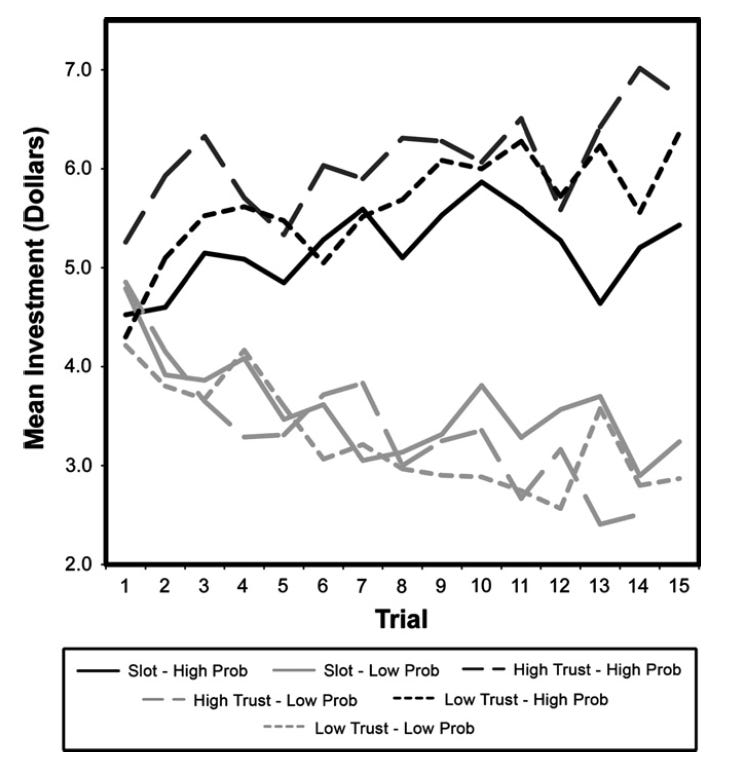
As the graph illustrates, the players soon determined successful strategies with each partner. Amounts tracked previous payouts and gradually increased or decreased as the test subjects observed each partner’s behavior. The pattern clearly shows evidence of reinforcement learning. This means people learn to trust in the same way we learn everything else, from how to dance to how to speak Spanish.
Notice the diagram shows how trust beliefs change over time. Investments varied significantly during the very first trial based on the faces they had seen. But by the second trial, test subjects started to figure things out. Note, however, that the “High Trust-Low Prob.” and “Low Trust-High Prob.” reversed-cases show latency. This reveals confirmation bias, the tendency to notice information that supports our beliefs while ignoring information that contradicts them. So just like it is in other situations, first impressions have lasting effects.
Building Trust
How can these concepts be applied in Customer Success? Making a strong first impression, explicitly stating your commitment to shared goals, and consistent, competent, and ethical behavior make your new customers believers in your trustworthiness. You should always:
Follow through on commitments, even the small ones. When you say you’ll get back to them Thursday, get back to them Thursday. Ability, in particular predictability and consistency in behavior, is one the three main trust drivers. Customers notice when you keep your word. If they can’t trust you on the small things, they can’t trust you on the big things.
Conduct effective Success Planning. As described in a previous article, good Success Planning properly sets expectations (Integrity), verifies and clarifies shared goals (Benevolence), and describes key success factors, essential guidance on how to achieve goals (Ability).
Share best practices, tips, and recommendations. Continually demonstrating your competence and acting in the customer’s best interests reinforces both ability and benevolence.
Provide frequent, honest, and candid communication. Customers naturally become suspicious when they hear everything is rosy despite the challenges or when they hear nothing at all. Do the right thing even though it’s the hard thing. Customers may be disappointed in what you tell them, but compromising your integrity is worse—they’ll learn not to trust you.
Prove realized value. Highlight when key goals and milestones have been achieved. Not only will customers trust that your solution has met its claims, they’ll trust you more, too.
Perhaps more than any other function, CS is in the business of earning customer trust. In the next issue of The Science of Customer Success, we’ll explore what to do when violations occur and how to restore trust. Be sure to subscribe so you don’t miss it!
