How to Make Breakthroughs
Hint: Being proactive isn't enough

LinkedIn is full of advice describing how Customer Success teams can be more proactive. A growing army of consultants says CS teams should detect upstream risk and mitigate it using their clever frameworks, insightful metrics, and newfangled AI. And in certain cases, these approaches can indeed move the needle.
But a few CS teams significantly outperform all others. They’re instead focused on prevention, helping their companies substantially reduce churn and increase sales not by treating symptoms but by identifying and addressing root causes. Results are dramatic, and Customer Success plays an integral role in making enterprise-wide breakthroughs.
With a six-step, scientific approach and good leadership, any CS team can do the same.
To begin with, what does good performance look like? Industry benchmarks such as the 2025 KeyBanc Capital Markets & Sapphire Ventures SaaS Survey (available for download below to paid subscribers of this Substack) show that the industry median Net Dollar Retention (NDR) is about 104%. The top 10% of companies, however, typically enjoy NDRs north of 120%.
Why do some firms do so much better than others? It’s not what they do. It’s how they do it.
Three Strategies
Most tech firms spend their time reacting. A CSM, for example, gets an email from a customer saying they won’t renew. She gets on the phone and tries to talk them out of it. Customer Success in these environments is just firefighting, acting like nothing more than a “save desk.” But typically only 10-15% of customers threatening cancellation will stay, and usually at a substantial discount for just another year. With a reactive strategy, revenue is low and costs are high.
Many teams, however, are more proactive. CSMs focus upstream in onboarding and account management, detecting churn risk and doing something about it. They contact at-risk customers and try to get them back on the “happy path.” And just like responding to a smoke detector alarm, putting out a small fire before it becomes a big one works 30-40% of the time.
But there’s a third strategy: prevention. Like using flame resistant materials in construction, CS teams ensure fires can’t happen. They work top-down and cross-functionally to minimize the probability of churn while creating ideal conditions for accounts to grow. And they don’t do it alone–the entire enterprise works toward this goal. It’s 90-95% effective.
How do we get there? It’s a six-step process:
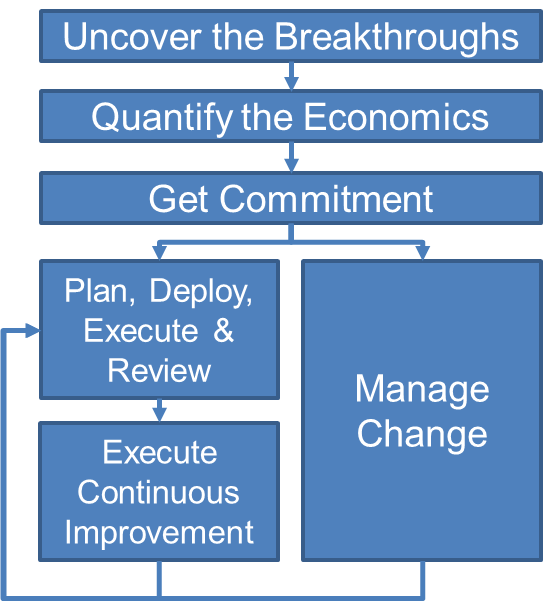
The Roadmap
The first step to uncover the breakthroughs is to ask “Why do some customers leave and why do others stay and buy more?” Asking why is core to the Scientific Method, recognizing that we don’t know and we’re curious. We seek the truth, understanding that our intuition and speculation can be wrong. We gather and analyze evidence to see if we’re right.
Asking why isn’t easy, which is why so few do it. It demands that we challenge our assumptions by slowing down, investing our precious time, and doing more analysis. We can’t, for example, simply take someone’s word about why a customer decided to cancel–we must go to the source. Having third parties conduct well-designed exit interviews or directly asking customers their reasons via required online workflows reveals the essential patterns.
The next step is to quantify the economics. Money is the language of business, and when we can show the return on investment, we can justify the actions that must be taken. One way to do it is Pareto analysis. It helps us separate the critical few items from the trivial many. In the example below, churn reason categories are shown on the x-axis, frequency of mention is on the first y-axis, and cumulative percentage is on the second y-axis:
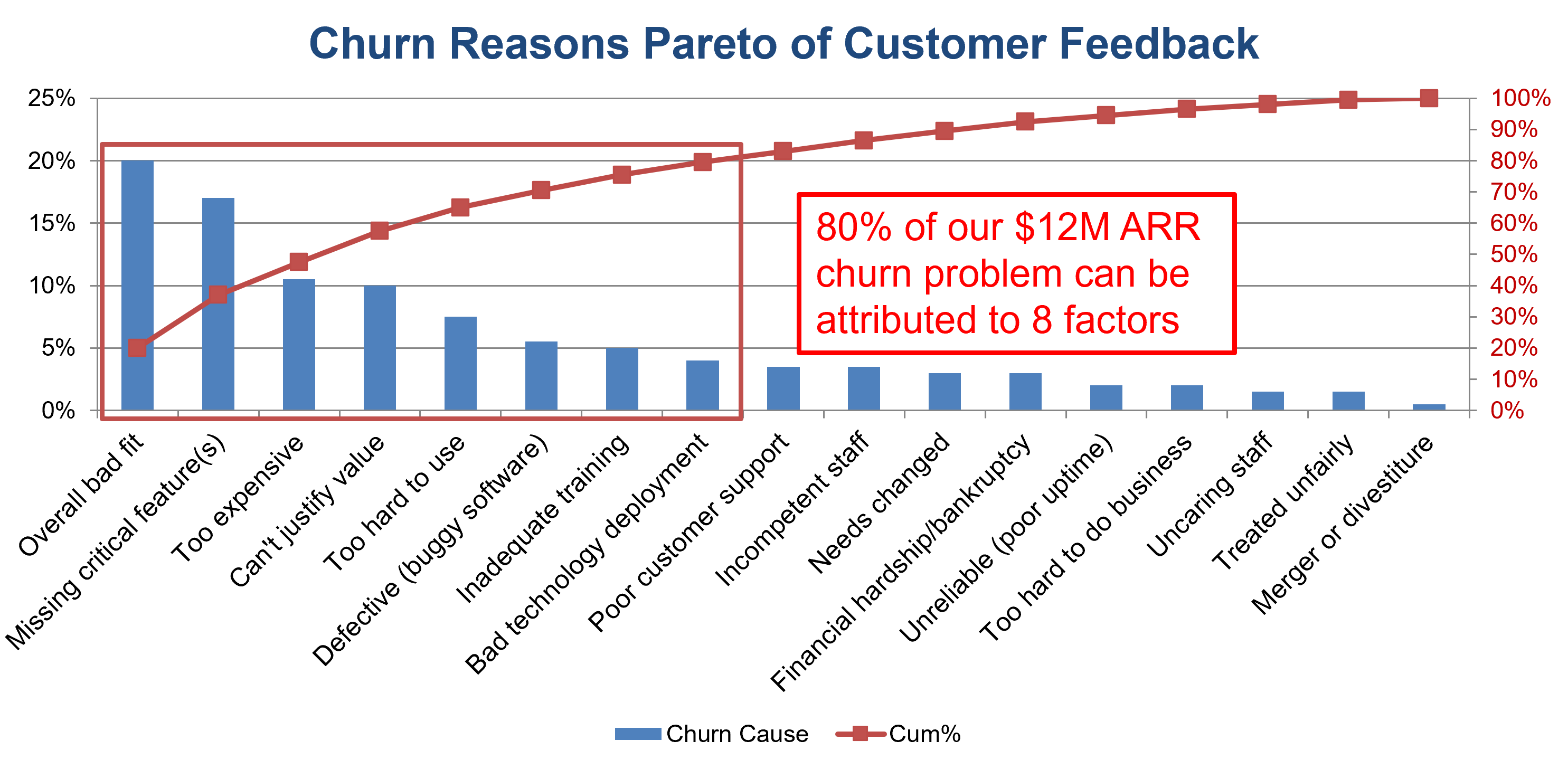
Here we apply the “80/20 Rule,” finding that 80% of the churn reasons customers cite have to do with lack of fit, product shortcomings, and implementation challenges. In this particular case, churn is significant, and $9.6M of a $12M ARR churn problem can be attributed to just 8 factors. These reasons deserve the greatest attention and will make the most impact.
Importantly, while Customer Success influences “Can’t justify value,” and “Inadequate training,” (about 15% of the problem), it doesn’t affect the rest. The remainder involves Product, Sales, and Professional Services, and it underscores an important fact: fighting churn takes a village. It can’t be done by a single department because the problems must be prevented at their source.
And herein lies another familiar challenge: silo-ism. As described in a previous Substack post, we humans naturally create artificial barriers in business that cause friction whenever workflows cross functional boundaries. As a result, departments groups turn inward, pursuing parochial goals instead of meeting those of customers or the business as a whole. It explains why addressing systemic issues always seems to take a back seat.
To change the status quo, a CEO must lead. The company’s top executive must recognize the propensity to create internal fiefdoms, and they must also appreciate their own unique role in mitigating the effects. Only the CEO oversees all the functions – the buck stops with them. As quality guru W. Edwards Deming remarked, “Quality begins in the boardroom.” Unless change comes from the top, things don’t change.
This brings us to the third step in the roadmap: Get Commitment. We must tell the story to the CEO in such a way as to cause them to decide and act.
How do we do that? John Kotter, recognized as the father of change management, offers an important clue. He says “People change what they do less because they are given an analysis that shifts their thinking than because they are shown a truth that influences their feelings.” In other words, the path is first through the heart, then the mind. We must therefore tell a compelling story about why a key account churned. If we have a recording or supercut of the customer telling their own story, we should play it. Then we share the Pareto analysis and financials, demonstrating that the example isn’t an isolated case and that multiple departments are to blame.
Moved by the discussion, the CEO will likely then ask, “So what do we do about it?” This brings us to the next step in the roadmap: we need a plan!
Planning and Executing Breakthroughs
We need structure to organize and drive improvement across an enterprise. One of the most powerful is a Japanese method called hoshin kanri, literally translated “compass management,” which points to the organization’s true north. It’s a top-down, closed-loop, strategic deployment approach that focuses the organization on a single, breakthrough objective. Very complex business problems can be broken down into manageable chunks, assigned to owners, implemented, and reviewed throughout. The hoshin structure maintains intense focus and embeds success metrics and accountability from top to bottom. It also reduces silo-ism because objectives, strategies and goals aren’t based on functional concerns but business priorities. Facilitating better alignment makes hoshin the most popular alternative to 1950’s-style “Management by Objectives.” It’s used by companies such as HP, Toyota, Danaher, Dow, Sony, IBM, and 3M.
Hoshin is ideally suited for improving GDR or NDR across the entire organization. An example is shown below. Senior leaders meet and craft a 1-page plan that articulates the business situation, the breakthrough objective and goal, and supporting strategies, owners, and success metrics. Each strategy owner then cascades and deploys their goal into smaller projects and assigns them to cross-functional teams for execution. In this example (No. 1.1), Angela is responsible for improving the opportunity fit process that surfaced in the Pareto analysis above. Her goal is to ensure 95% of closed sales align with the company’s Ideal Customer Profile (ICP).

Breakthroughs, however, are rarely “one and done.” We also need a method for continuous improvement, and Six Sigma is the world’s most popular and effective approach. At its heart is the DMAIC cycle: Define, Measure, Analyze, Improve, and Control. After clearly defining (D) the problem to be solved, we baseline metrics (M) to evaluate improvement and then use formal scientific methods to uncover and validate root causes of problems (A). Once we identify the underlying issues, our solutions (I) are more targeted and effective, and after deployment, we put controls (C) in place to hold the gains.
Here Angela oversees a Six Sigma project described in the hoshin example above:
Define: 20% of $12M lost ARR is due to ‘bad fit’
Measure: 90-day logo churn average is 12.5%
Analyze:
70% of ‘bad fit’ pertains to one customer segment
‘5 Why’: lack of segment focus, lack of onboarding post-mortems, lack of technical qualification
Improve:
Define segment requirements & add new features
Onboarding reviews
Tech qualification checklist
90-day churn drops to 5%
Control:
Updated playbooks
Segment-specific training
Fit rating added to Customer Health Dashboard
As a result of this project, initial churn drops dramatically. Angela also achieves her Hoshin strategy to improve ICP Match to 95%.
Leading Change
The most difficult aspect in any transformation is the “people-side” of change. Even when we perceive gains, behavioral scientists say we humans naturally overreact to perceived risks. Potential threats to our social status, certainty, autonomy, relationships, or being treated fairly as a consequence of the change cause us to push back. We then fail to accept and adopt the change, and the intended business results never materialize. And even when we are fully committed, our entrenched habits get in the way. It takes plenty of reinforcement, effort, time, and patience to adapt to the new routine and become fully productive.
To meet this challenge, there are many different change management frameworks in use today, and Prosci’s ADKAR model is among the best known and most effective. It defines the phases of successful individual change:
Awareness–what the change is and why it’s important
Desire–emotional commitment to participate and support the change
Knowledge–how to change, usually addressed through training
Ability–supporting processes, technologies, metrics, policies, etc. enabling the change
Reinforcement–regular cues that trigger the new routine and rewards that come from it
Prosci’s method is scalable depending on the scope and magnitude of the transformation. The approach provides direction to senior leaders on how to communicate and build coalitions, and it prepares front-line managers to support their employees every step of the way. As a result, more people engage and embrace the change, improving the likelihood of achieving project goals by a factor of 7, according to Prosci’s research.
When all aspects of this roadmap are well designed and executed, we create breakthrough levels of performance. ROI from the Customer Success function is never in question. And the EVP or CCO earns a seat at the table, supported by their team and focused on helping the enterprise prevent, rather than react, to chronic problems.
